
What happened?
On January 16, 2003, Space Shuttle Columbia launched on mission STS-107. At 81.7 seconds after launch, insulating foam separated from the left bipod ramp of the External Tank. At 81.9 seconds, it struck the leading edge of Columbia’s left wing.
During the mission, engineers on the ground analyzed possible damage and several efforts were made to obtain additional imagery. The mission nevertheless continued without a determination that Columbia had suffered catastrophic damage. During re-entry on February 1, superheated air entered through the damaged Thermal Protection System at the left wing leading edge, progressively weakening the wing until the vehicle broke apart. All seven crew members died.
The Columbia Accident Investigation Board (CAIB) examined not only the physical cause but also how earlier foam shedding had been handled, schedule pressure, the in-flight analysis, imagery decisions and the way information moved through management. Volume I was published on August 26, 2003.
Background overview: Space Shuttle Columbia disaster (Wikipedia)
Twelve passages that stood out
Briefing slides prepared for NASA leaders and engineers’ e-mails show how decisions were made at the time.
A countdown screensaver distributed by NASA Headquarters. Employees using the word “tricks” for ways to regain schedule margin. Engineers working through a holiday weekend. An unanswered e-mail. An imagery request cancelled within 90 minutes. A warning e-mail that was printed instead of sent. A debris discussion missing from the official minutes. And a 640-fold mismatch placed at the bottom of a PowerPoint slide.
Page references are the printed pages of CAIB Report Volume I.
Foam had fallen on a recent flight too. The next flight still went forward with 'no added risk'
Two missions before Columbia, STS-112 also lost foam from the External Tank bipod ramp. Because of the size of the loss and the damage it caused, the Board examined closely why NASA continued flying afterward.
The Intercenter Photo Working Group initially recommended classifying the event as an In-Flight Anomaly. The Program Requirements Control Board did not do so. Instead it assigned an “action” to the External Tank Project to identify the root cause and propose corrective action. The due date was initially set after the next launch and later slipped until after STS-107’s planned return.
A slide used for the STS-113 Flight Readiness Review said the External Tank was safe to fly with “no new concerns (and no added risk).”
The Board wrote that this decision allowed two missions—STS-113 and STS-107—to fly before the STS-112 foam loss was resolved, and helped make similar reasoning available when managers later assessed the STS-107 strike.
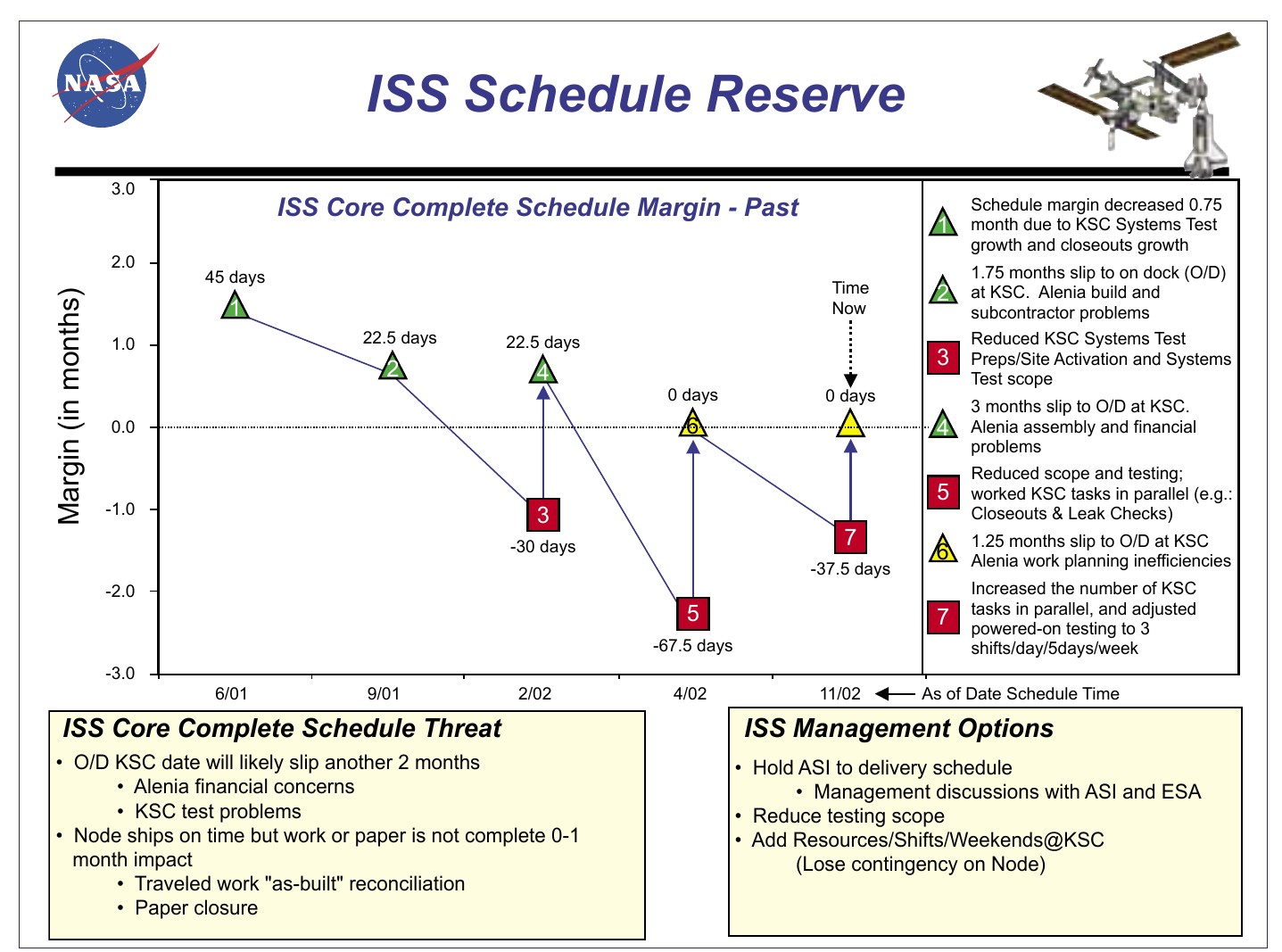
More than half of the monthly briefing slides to the NASA Administrator were typically about days of schedule margin
The Space Shuttle and International Space Station programs were managing toward the planned February 19, 2004 launch of Node 2, a major Space Station assembly milestone.
Program managers briefed the new NASA Administrator monthly. One of the central metrics was the number of days of schedule margin remaining before the Node 2 launch.
The CAIB report says Node 2 schedule margin typically accounted for more than half of the briefing slides.
The examples reproduced in the report also show actions intended to regain time, including holiday and weekend work, reducing some testing, performing more work in parallel and adding shifts.
NASA Headquarters distributed a screensaver counting down to February 19, 2004 in days, hours, minutes and seconds
NASA Headquarters also emphasized the February 19, 2004 U.S. Core Complete date through a computer screensaver sent to managers and employees in the human-spaceflight program.
The screensaver reads “COUNTDOWN TO Space Station Program US Core Complete February 19 2004.”
In the reproduced image, “477 days to go” is followed by hours, minutes and seconds still remaining.
The Board says some employees found the screensaver amusing because they believed the date could not be met. At the same time, it reinforced the message that NASA Headquarters was focused on achieving that date.

Some employees called the ways used to regain schedule margin 'tricks'
Because Shuttle and Station missions had become tightly linked, employees described how a one-week delay could cascade through constraints and become a delay of months.
By the fall of 2002, both programs were finding it increasingly difficult to regain schedule margin through existing measures.
The Board writes that the two programs began using what some employees termed “tricks” to regain schedule margin.
The same section records concern from workers that the rapid sequence of missions was leaving too little time to work problems correctly.
Management said the debris problem would not be worked over the holiday weekend. Boeing engineers worked through it anyway
After the foam strike was identified, NASA and contractor engineers began forming the group that became the Debris Assessment Team.
Before the Martin Luther King Jr. holiday weekend, a senior United Space Alliance manager told Mission Evaluation Room personnel that the debris problem would not be worked during the weekend.
Boeing engineers nevertheless worked through the weekend and performed a preliminary damage assessment on Saturday.
Their estimates of the debris size and velocity later proved, in the Board’s words, “remarkably accurate.”
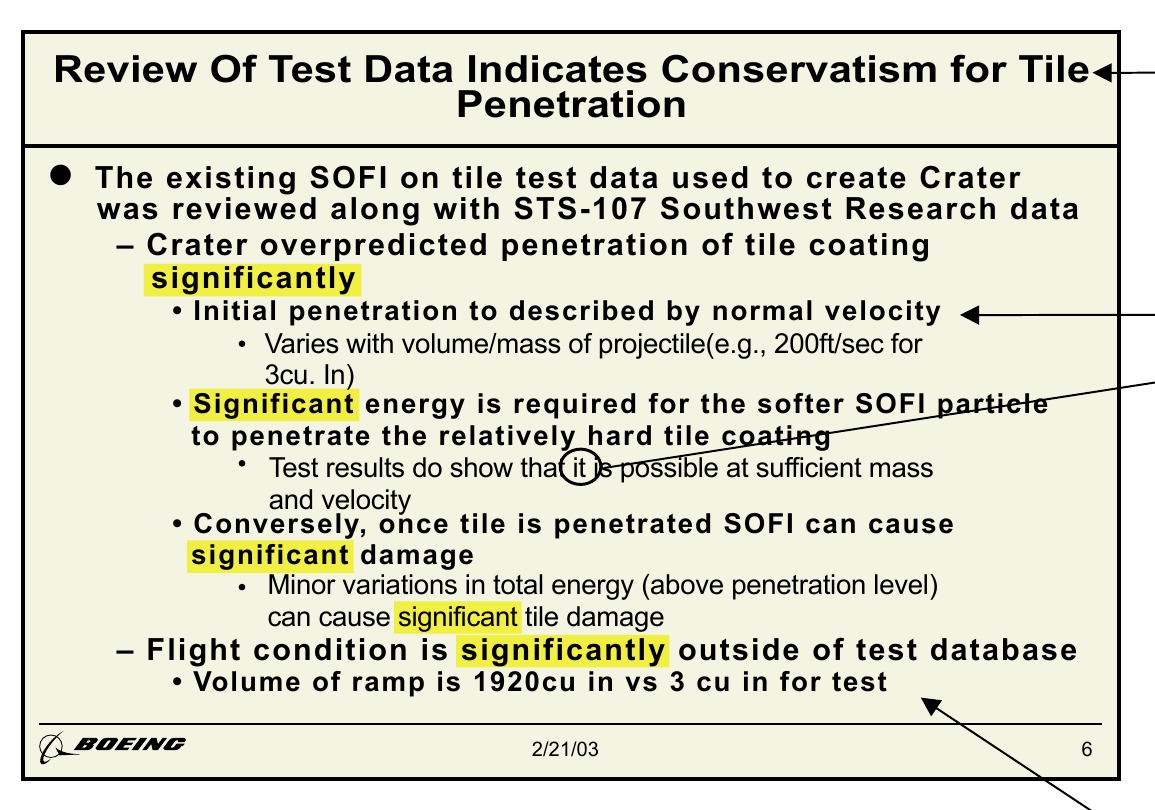
The analysis reached as far as 640 times beyond the calibration data. The Crater operator had used the program only twice before
Boeing engineers used a mathematical model called Crater to predict how deeply debris would penetrate Thermal Protection System tiles. It had been calibrated and validated using relatively small foam, ice and metal debris, with a maximum test volume of three cubic inches. For the wing leading-edge Reinforced Carbon-Carbon (RCC) panels, analysts used a separate Crater-like algorithm calibrated with ice-impact tests.
The Board says many characteristics used in the STS-107 analysis were far outside the validated envelope. One debris estimate was as much as 640 times larger by volume than the data used to calibrate the model. The Board’s later best estimate put the actual object at roughly 400 times larger.
The engineer who entered the STS-107 values into Crater had received formal training, but had limited practical experience.
He had used Crater only twice before and had reservations about applying it to the piece of foam that struck Columbia.
He also did not consult the more experienced Huntington Beach engineers who had previously performed or overseen Crater analysis. Responsibility had just moved to Houston in January 2003, and STS-107 was the first mission without direct Huntington Beach involvement.
'Is a crew inspection of the left wing in progress?' The e-mail received no answer
The Board labels several points during the mission as “MISSED OPPORTUNITY.” Its first example involves Rodney Rocha, NASA’s designated chief engineer for the Thermal Protection System.
On Sunday, Rocha e-mailed a Johnson Space Center Engineering Directorate manager to ask whether a Mission Action Request was being prepared for Columbia’s crew to visually inspect the left wing.
The Board records that his inquiry went unanswered, treating it as the first of the missed opportunities it identified.
This was not a simple matter of looking out a window. The report notes that the inboard RCC panels could not be seen from inside the Orbiter, and Columbia did not carry a manipulator arm on STS-107, so a direct visual inspection would have required a spacewalk.
The earlier flight rationale was 'lousy then and still is,' Linda Ham wrote
During Flight Day Six, the Mission Management Team revisited the rationale NASA had used after the STS-112 foam loss to conclude that Shuttle flights could continue.
Mission Management Team Chair Linda Ham reviewed the earlier Flight Readiness Review material and sent an e-mail to Shuttle Program Manager Ron Dittemore.
Ham sharply criticized the earlier rationale for continuing to fly after the STS-112 foam loss, even though the review had concluded there was no added risk.
In the same e-mail she summarized the logic as essentially: nothing had changed, there had been no safety-of-flight damage in 112 flights, the risk was the same as before, so the External Tank was safe to fly with no added risk.
The Board also interprets Ham’s attention as having shifted toward the downstream implications for STS-114 and the schedule if that rationale proved flawed.
You probably can’t open the attachment. But, the ET rationale for flight for the STS-112 loss of foam was lousy.
Rationale states we haven’t changed anything, we haven’t experienced any ‘safety of flight’ damage in 112 flights, […] So ET is safe to fly with no added risk
Rationale was lousy then and still is....The January 22 request for Department of Defense imagery preparations was made and rescinded within 90 minutes
Engineers sought better on-orbit images of Columbia through several channels. On the morning of January 22, Wayne Hale asked a Department of Defense representative to start planning to image Columbia; military representatives began identifying ground-based and other imaging assets.
At 8:30 a.m. on January 22, the NASA liaison officer called USSTRATCOM and cancelled the request. The stated reason was that NASA had identified its own in-house resources and no longer needed military assistance.
The Board says the January 22 morning request for the Department of Defense to prepare to image Columbia was both made and rescinded within 90 minutes.
The Board also found that nobody in the STS-107 operational chain of command had the security clearance needed to know about National imaging capabilities, and that it found no evidence anyone investigated the likely image quality, difficulty or cost.
It concluded that Mission Management Team members were making critical imagery decisions based on “little or no knowledge.”
Rocha wrote that the decision was 'wrong' and 'bordering on irresponsible'—then printed the e-mail instead of sending it
After learning that Program management was not seeking outside imagery, Rodney Rocha called Paul Shack to ask whether the engineering director knew about the request. Rocha then drafted an e-mail explaining his concerns.
In the draft, he described the decision not to request additional imagery as, in his “humble technical opinion,” “wrong (and bordering on irresponsible).”
Rocha did not send the e-mail. He printed it out and shared it with a colleague instead.
When the Board asked why, Rocha said he did not want to jump the chain of command. Having already raised the need for imagery with Shack, he deferred to management’s judgment.
The debris strike was discussed in the meeting. The signed official minutes did not mention it
The January 24 Mission Management Team meeting included a discussion of the debris assessment, including the possibility of substantial tile damage and the belief that there was no burn-through and therefore no safety-of-flight issue.
The official record told a different story.
When the January 24 minutes were produced, distributed, approved and signed, there was no mention of the debris strike.
The Board notes that anyone who had not attended the meeting and relied on the minutes to learn the key issues would have read nothing about the debris-strike discussion between Don McCormack and Linda Ham.
The 640-fold mismatch was placed at the bottom of a PowerPoint slide
The Board also examined how the Debris Assessment Team’s engineering analysis was presented upward. Drawing on information-design expert Edward Tufte’s review, it describes one PowerPoint slide as creating six levels of hierarchy out of 11 simple sentences.
Only at the bottom of the slide did engineers state that one debris estimate was 640 times larger than the data used to calibrate the model behind the damage assessment.
The Board writes that as information moved up the hierarchy, key explanations and supporting information were filtered out, making it easy for a senior manager to read the slide without recognizing that it addressed a life-threatening situation.
It also says the Board was repeatedly surprised during its investigation to receive similar presentation slides from NASA officials in place of technical reports, and treats the endemic use of PowerPoint briefing slides instead of technical papers as an example of problematic technical communication.
What the report says about the background
The CAIB did not reduce the Columbia loss to a piece of foam striking a wing. It explicitly gave organizational causes weight comparable to the physical cause.
Those organizational issues included the way repeated foam shedding became less likely to be treated as a safety-of-flight anomaly, the increasingly complex Shuttle and Space Station schedule, the filtering of engineering concerns as information moved upward, the role of formal requests and chain-of-command boundaries, and a safety organization that the Board did not view as sufficiently independent or forceful.
At the same time, the report does not make the simplistic claim that “schedule pressure caused the accident.” Its analysis is about interacting conditions: prior success, normalization of risk, organizational structure, technical communication, decision-making practices and schedule pressure.
Corrections to this article
Distinguished foam separation at 81.7 seconds from impact at 81.9 seconds and clarified the separate tile-damage Crater model and RCC algorithm. The 90-minute interval concerns the January 22 morning request for Department of Defense imagery preparations, rather than all imagery efforts. Clarified that the subtitle’s criticism concerned the decision rather than the email itself, and corrected the Japanese account of the phone inquiry. Reclassified documented emails, witness accounts and Board assessments, and expanded references for briefing figures, the screensaver, emails, imagery preparations and meeting minutes. Japanese wording about STS-112 being two missions earlier and schedule margin was also corrected.