
What happened?
In April 2023, Daihatsu disclosed that door trim on certification test vehicles for four overseas models had been modified in a way that differed from production vehicles. The following month, the company disclosed another issue involving the Daihatsu Rocky HEV and Toyota Raize HEV: data from a left-side pole collision test had been submitted where right-side test data was required.
The Independent Third-Party Committee widened the investigation and identified 174 similar irregular acts across 25 test items. Daihatsu said the affected scope covered 64 vehicle models and three engines, including discontinued models. The full Japanese investigation report published on December 20, 2023 is 162 pages. The English text below is a From Reports translation and summary of the Japanese original.
Background overview: Daihatsu (Wikipedia)
Ten passages that stood out
The most revealing parts are often the operational details: what happened after the wrong side of a car was tested, what an inspector saw, what happened when an ECU was not ready, and how managers responded when staff raised problems. The report also records sharp reductions in safety-evaluation staff and distrust of the internal whistleblowing process.
The wrong side was tested. With no spare car or time left, the left-side result was submitted as the right-side result
The Rocky HEV and Raize HEV pole-side collision certification required results for both passenger and driver sides. A vehicle intended for the right-side filing test was mistakenly crashed on the left side instead.
When it came time to submit the right-side result, the team recognized that the right-side test had never been run.
With neither another test vehicle nor enough time to rerun the test, the left-side in-house result was submitted as if it were the right-side result.
The report says the person involved also believed there was no safety problem.
After hearing about an internal report, the modified door trim was restored for the inspector—then cut again afterward
For a vehicle still under development, the team planned to cut the back of the front-door trim so it would fracture in a more favorable way during the side-impact certification test.
The person responsible then learned that information had surfaced about a report alleging the use of modified vehicles in certification testing.
Before the inspector looked at the car, the modified trim was hurriedly replaced with the normal specification. After the inspection, cuts that would be difficult to verify later were added again before the next day’s test.
The airbag ECU was not ready, so the airbags were triggered by a timer during the certification test
In a side-impact test, the vehicle’s airbag ECU should detect the collision and deploy the side and curtain airbags. Daihatsu sometimes combined development-data collection with a certification filing test in order to shorten schedules and reduce the number of test vehicles.
That created cases where the model-specific ECU setup was not finished by the combined test date.
In those cases, the airbags were deployed by a timer rather than the vehicle’s ECU, and the resulting data was used in certification applications.
The people involved believed the production ECU would be ready before mass production and that vehicle safety would therefore not be affected.
The legal limit was 42 mm. A result above it was changed to 41.5 mm in the processing system
The committee found that, after a crash dummy’s chest-deflection result exceeded the 42 mm legal limit in a 1998 European-model side-impact test, the following alteration took place.
To obtain a passing certification result, the strain value was manipulated so the processing system output 41.5 mm, which was then submitted to the inspector.
No test data directly substantiating this act were found. The committee reached its finding after carefully assessing the credibility of testimony against objective evidence.
The report also notes that a later design change improved the model’s crash performance and a subsequent Japanese-specification test produced a result comfortably within the limit.
Managers said staff could bring them anything. Employees described actually doing so and getting a simple “So?”
The committee concluded that front-line employees often had little reason to expect a problem would be solved by escalating it to management.
Interviewees described managers who nominally invited consultation but, when approached, responded by asking about the mistake, the schedule and what the employee intended to do rather than offering constructive help.
One description in the report contrasts an invitation to “ask me anything” with the response employees felt they actually received: essentially, “So?”
Saying a deadline could not be met created more work explaining why it could not be met
Employee survey responses described a pattern in which raising a schedule problem led to additional demands to explain why the deadline could not be met, how it could be made to fit, and what the employee would do next.
Some respondents said that speaking up about something being impossible increased their workload, encouraging people not to raise the issue at all.
Another survey response described schedule extensions and extra staffing as excluded options, leaving employees to cope with existing resources. The committee separately assessed that a culture of solving one’s own problems encouraged staff to keep certification problems at the front-line level.
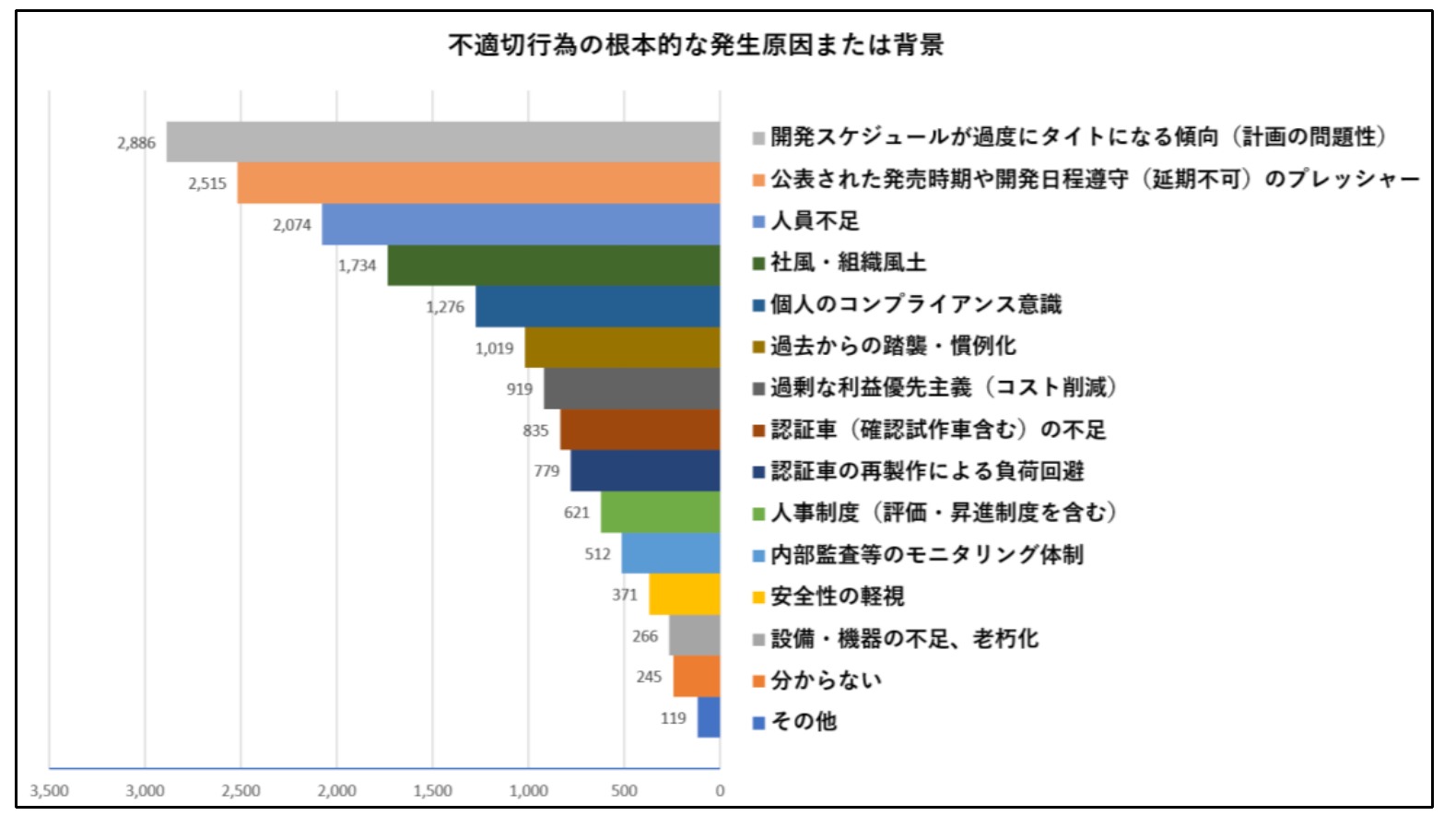
The internal test report and the certification document sent to authorities were not routinely checked against each other
The switched left/right pole-collision data was easy to discover once investigators compared the certification test sheet submitted to authorities with the internal experimental report and saw that the records contradicted each other.
Yet there was no established process that routinely compared those two documents for consistency; checking was effectively left to the individual responsible.
The committee considered that a proper cross-checking process could likely have prevented many false-entry cases.
A certification worker told the committee they had never received training on certification regulations
The committee said the certification system was highly specialized while Daihatsu lacked enough experienced staff and continuing regulatory education.
Interviewees responsible for certification work described having received no certification-law training and preparing documents without being sure what the correct answer was.
The report also notes that employees used a term equivalent to “official test” for witnessed certification tests, even though filing-based tests were also formal certification tests. The committee considered that this distinction contributed to the filing-based process being treated too casually.
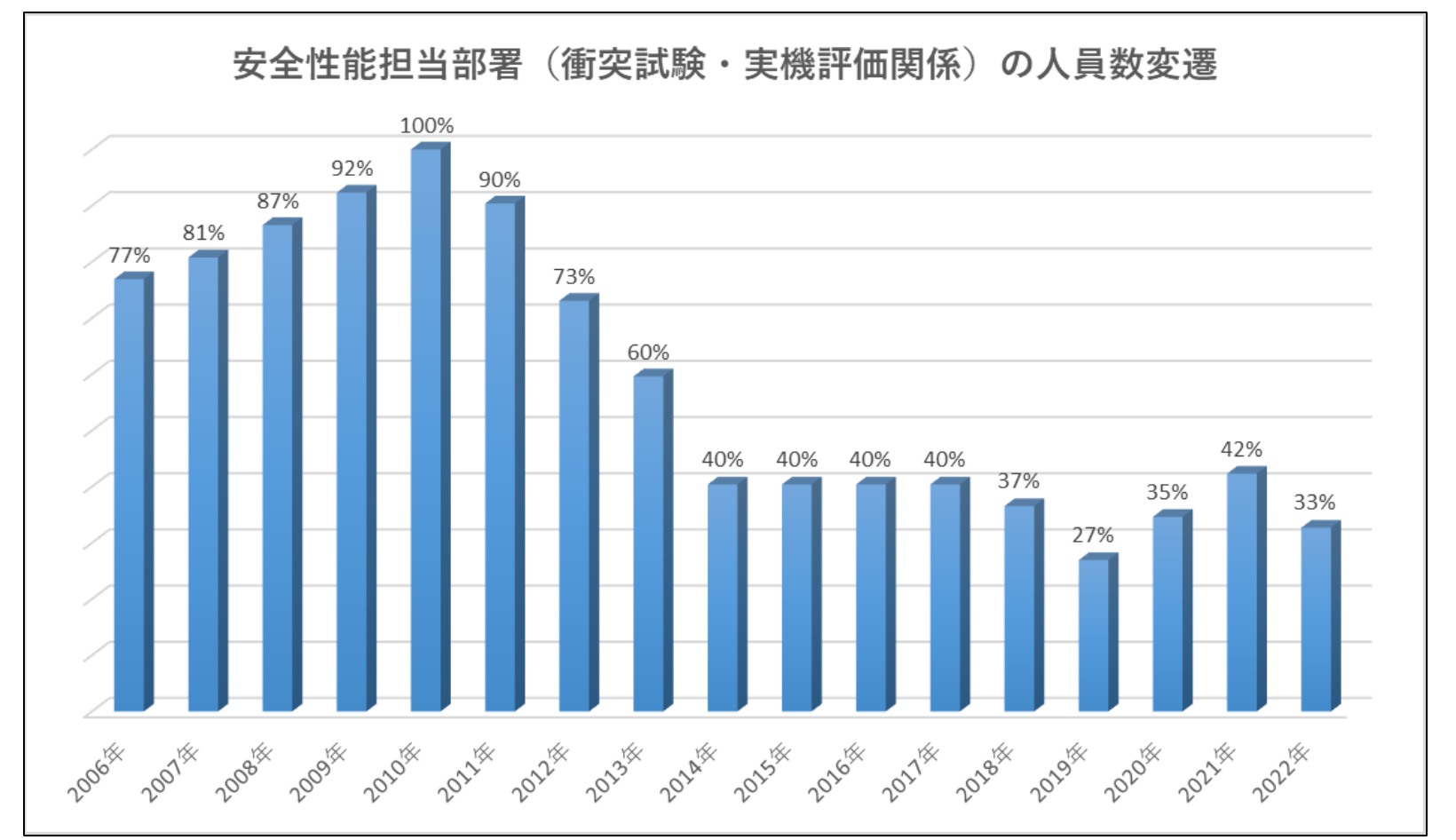
Collision-test safety evaluation staff fell to 27% of their 2010 level by 2019
The committee examined staffing cuts as part of its findings about a shortage of employees with expertise in certification regulations. From around 2011, staffing was reduced not only in the regulatory certification office but also among safety-department personnel responsible for the physical evaluation of collision testing.
The report’s chart indexes the relevant safety-evaluation workforce at 100% in 2010, 40% in 2014, just 27% in 2019, and 33% in 2022.
This chart covers people engaged in the physical evaluation of collision testing. It does not include CAE simulation analysts or the staff who actually perform the tests. The committee also noted that continuing education in certification regulations was insufficient.
Internal reports were investigated by the department concerned. Employees feared a hunt for the whistleblower
Daihatsu had operated an internal reporting system called “Employee Voice” for years, with regular reporting to senior executives. Yet the committee found no reports directly suggesting this certification misconduct, apart from certain submissions related to its contributing factors. An external report ultimately triggered disclosure.
In 2022, about 60% of internal whistleblower cases that proceeded to investigation were referred back to the department where the issue had occurred.
A survey respondent described a fear that the manager of the department would be contacted and that a hunt for the whistleblower would begin. The committee warned that investigations by the department involved could lack independence, while anonymous reporters were not informed of the result even when a contact address was known. These practices could reinforce mistrust.
What the report says about the background
The committee pointed to extremely tight and inflexible development schedules, management that left practical problems to front-line staff, black-boxed specialist work, insufficient regulatory understanding, and a diminished sense of the significance of certification testing.
The passages above show two pressures operating at the same time: certification tests were expected to pass, while raising a problem upward did not reliably create a path to change the schedule or obtain help. From Reports keeps those individual acts separate from the committee’s later causal analysis.
Corrections to this article
Note 04 is now labeled as a committee finding and testimony, with the report’s qualification that no directly supporting test data were found (pp.36–37). Note 06 distinguishes a survey response about existing resources from the Committee’s assessment. Page references for notes 01, 07 and 08 were also corrected.