
What happened?
In 2015, an Independent Investigation Committee found that Toshiba had continued inappropriate accounting practices over a number of years in areas including percentage-of-completion accounting, operating expenses in the Visual Products Business, parts transactions in the PC Business, and semiconductor inventory valuation. The report’s adjustment table gives a cumulative pre-tax adjustment of negative JPY 151.8 billion for FY2008 through the third quarter of FY2014, within the committee’s scope.
The committee interviewed 210 officers and employees, reviewed documents and accounting materials, and used digital forensic investigation. It examined not only individual entries but also Toshiba’s “Challenge” targets, profit-and-loss adjustments called C/O, the role of finance and audit functions, and corporate culture. The Japanese report is dated July 20, 2015 and Toshiba published the full version on July 21. Toshiba later published an official English translation; this article uses that 334-page English edition for its English page references.
Background overview: Toshiba (Wikipedia)
Twelve passages that stand out
The report shows inappropriate accounting becoming more than a series of isolated decisions. It developed its own terminology and management routines. These twelve notes move from last-minute profit demands to C/O “Debt,” repayment plans and double-standard performance figures, then to the accounting and audit functions that were supposed to provide checks, and finally to the committee’s analysis of corporate culture.
A week after being told to redo the plan, JPY 12 billion of improvement was demanded with three days left
In September 2012, the DS Company, which included the PC and Visual Products businesses, was facing a sharply worsening first-half operating result. At a September 20 CEO Monthly Meeting, a JPY 8 billion improvement plan was rejected as insufficient and management was told to revise it.
At another meeting on September 27, the forecast had deteriorated further. Management then demanded JPY 12 billion of operating-profit improvement in the three days remaining before quarter-end, with the results of the review due the next day.
JPY 12 billion of improvement was demanded with only three days remaining in the quarter.
The committee later used this episode as an example of Challenge targets being imposed when ordinary sales efforts could not realistically deliver the required improvement in time.
The possibility of worldwide withdrawal was raised while profit improvement was demanded
In August 2013, a message concerning the Visual Products and related businesses warned that failure to improve performance could lead Toshiba to reconsider its position and withdraw from the businesses worldwide, including Japan. The message also stated that the warning was not intended as a threat.
The following month, after a public commitment to return the TV business to profitability in the second half, management again pressed the business to use all available means to deliver the target.
The possibility of worldwide withdrawal was placed alongside a strong demand to restore profitability.
The committee presented these communications as part of the intensifying pressure placed on the Visual Products Business.
C/O had a definition that explicitly included accounting inappropriateness
In the Visual Products Business, C/O broadly referred to measures used to adjust profit and loss by, for example, deferring expenses or recording profit early so that apparent current-period profit looked better.
When the Finance & Accounting Division and others tried to define C/O in 2011, their discussion proceeded on two conditions: the treatment shifted profit or expense between periods, and it was inappropriate from an accounting perspective.
The internal attempt to define C/O treated accounting inappropriateness as part of the definition.
The committee concluded that almost all C/Os managed as C/O Balances were in fact inappropriate accounting treatments.
C/O balances were called 'Debt,' and reducing them was treated as repayment
A C/O could make one period look better only by worsening later periods. The report says the C/O Balance was therefore referred to as “Debt.” Reducing that balance was handled as repayment.
Materials for a November 2011 CEO Monthly Meeting even contained a payment plan with priorities. The first priority was C/O items that needed to be addressed with the auditors, followed by Buy-Sell and then other C/Os.
C/O balances were managed as “Debt,” with an explicit repayment plan and priorities.
This was not merely informal slang: the balance was tracked and discussed as something that had to be repaid over later periods.
A management document described Buy-Sell and FOB-UP as 'gray close to black'
Some C/O methods included FOB-UP, which adjusted prices used in transactions with overseas affiliates. Materials prepared for a CEO follow-up meeting in July 2012 included a table on C/O and Buy-Sell balances and used language that clearly signaled concern about the methods’ propriety.
Other management materials referred to measures not being implemented because they had been judged unacceptable or had been identified in prior audits, and used labels such as poor inventory and special inventory.
A CEO-level document described Buy-Sell and FOB-UP as “gray close to black.”
The committee also considered the repeated presentation of such materials when assessing what senior management could have understood about C/O.
Performance was managed using disclosed figures and a second set of figures with C/O effects removed
To understand the underlying operating result of the Visual Products Business, the DS Company tracked not only the figures after C/O effects were included but also figures with those effects removed.
The official English report calls this a “double standard” for managing profit and loss. At CEO Monthly Meetings and similar meetings, reports included both C/O balances and figures with their profit-improvement effects removed.
The business kept disclosed figures and a second set of figures with the C/O effects removed.
That made it possible to see separately how the business performed and how much the C/O measures changed the reported result.
The accounting function itself asked divisions to maximize C/O
The Finance & Accounting Division was expected to provide an independent check on accounting treatments. The committee found that its checking function did not work for inappropriate C/O and that the division gradually took a proactive role instead.
In January 2013, the head of the DS Company Finance & Accounting Division asked division heads to re-examine items other than FOB-UP so that C/O could be increased as much as possible. An August 2013 internal communication also referred to hidden amounts outside the reported C/O figure.
The function expected to provide accounting control was itself asking divisions to maximize C/O.
The committee found that, by 2012 at the latest, accounting personnel were examining and proposing inappropriate C/O items and preparing explanations for auditors.
An overseas subsidiary questioned whether the transaction was abnormal, but it still went ahead
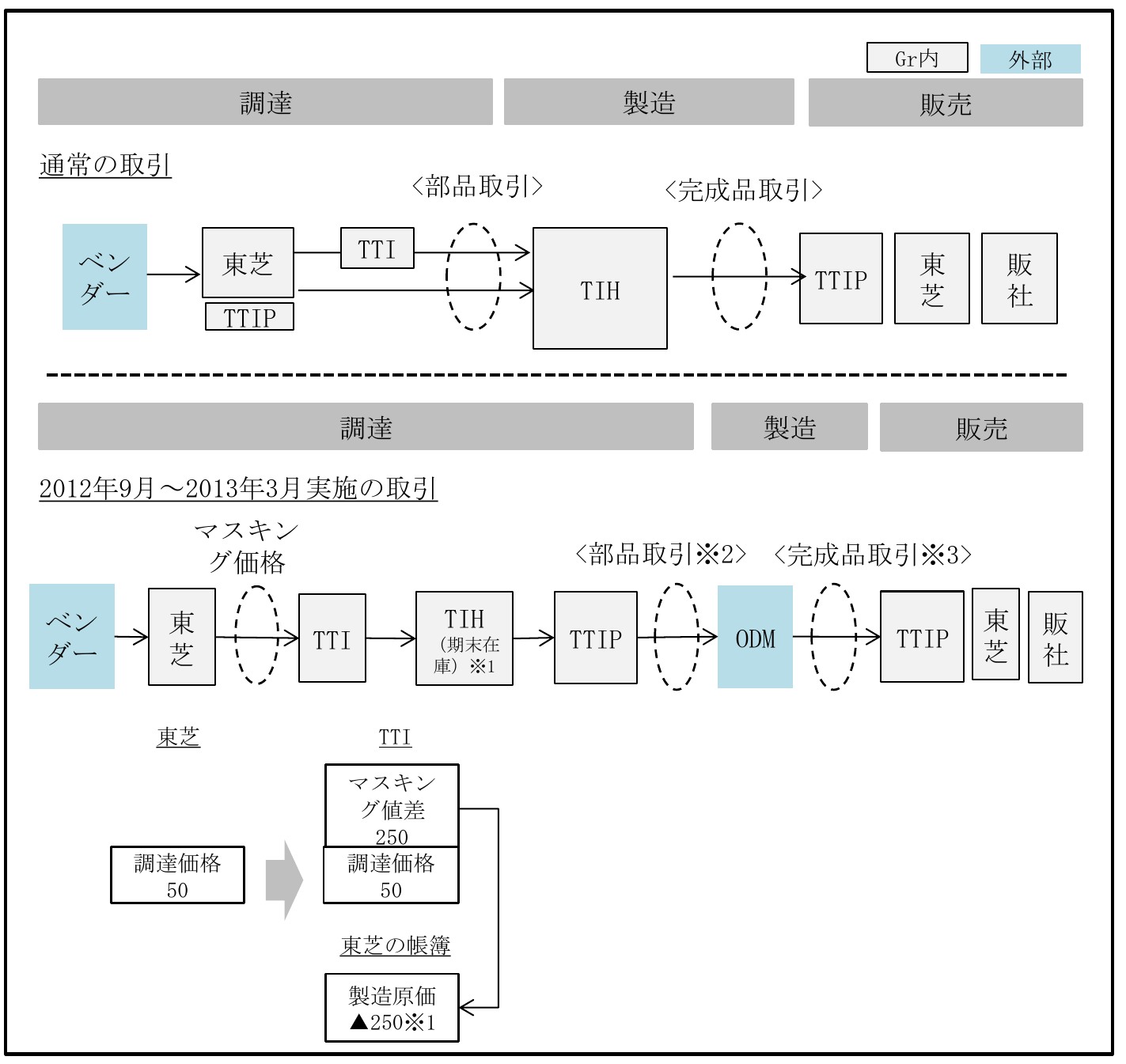
In December 2012, the PC Business directed a parts transaction with an overseas subsidiary using a “Masking Price” above procurement cost. The committee said there was no need to sell parts at that price to a wholly owned Toshiba subsidiary.
The subsidiary raised concerns that the request was abnormal, that the accounting treatment could attract suspicion, and that the instruction should only be given with full awareness of the risk. The head of the DS Company Finance & Accounting Division responded that audit risk had already been explained to a senior executive and still asked the subsidiary to proceed.
The transaction went ahead after the overseas subsidiary had explicitly raised accounting and audit-risk concerns.
The committee estimated that the transaction increased apparent profit by JPY 3.4 billion in the third quarter of FY2012.
The president approached the CFO with a confidential proposal to increase Buy-Sell again
By 2013, Toshiba had been considering how to reduce the apparent profit built up through Buy-Sell transactions in the PC Business.
The report records the president approaching the CFO on a confidential basis with a proposal that differed from the existing reduction policy: increase Buy-Sell somewhat again to improve the DS Company’s profit and loss. The CFO said he would follow a presidential decision, but personally opposed increasing Buy-Sell.
A method being reduced was proposed for expansion again in order to improve the current result.
The committee relied on this and other communications in assessing senior management’s awareness that Buy-Sell transactions were overstating apparent profit.
The report records a confidential proposal and reply
There is something I would like to talk to you about. Although this differs a little from the policy up until now, I would like to increase the Buy-Sell Debt a bit and do whatever it takes to ensure that losses for the DS Company are no more than JPY 9.9 billion.
While I obey any decisions made by Hisao Tanaka P 100% and do my best, I am opposed to increasing Buy-Sell Transactions.
A CFO who knew about C/O later chaired the Audit Committee
The committee found that the person who served as CFO from June 2011 to June 2014 had detailed knowledge of C/O in the Visual Products Business.
He became chair of the Audit Committee in June 2014, but did not raise inappropriate C/O as an issue after taking that position.
The CFO who knew the details of C/O later became chair of the committee responsible for auditing it.
The committee considered the resulting self-audit of C/O he had tacitly permitted as CFO to be one reason the Audit Committee’s controls did not function.
The committee identified a corporate culture in which employees could not act against superiors' intent
In its overall cause analysis, the committee moved beyond individual accounting entries and examined Toshiba’s corporate culture.
For significant accounting matters, it found a de facto rule under which increasingly senior approval had to be obtained before staff carried out the treatment required by written accounting rules. If approval was not obtained, the proper treatment could fail to be carried out at all.
Written accounting rules could effectively be subordinated to obtaining a superior’s approval.
The committee linked this practice to a culture in which employees could not act contrary to the intent of their superiors.
The recommendations explicitly called for abolition of the 'Challenge' policy
The committee’s recommendations went as far as Toshiba’s budgeting and performance-target system. It did not reject target setting itself. It focused on Challenges built on budgets beyond corporate capability and then enforced as compulsory targets even near quarter-end, when normal sales efforts could no longer generate the required improvement.
The committee recommended abolishing Challenge initiatives of that nature and timing.
It also recommended budgets and long-term plans that were feasible and reasonable in light of the company’s capabilities, together with a shift away from singular focus on current-term profit.
What the report says about the background
The committee identified direct causes that included institutional behavior involving top management, pressure to overstate current-term profit beyond what was attainable, an overriding current-term-profit policy, strong pressure to meet budget targets, a culture in which employees could not act against superiors’ intent, and insufficient awareness or knowledge of appropriate accounting treatment.
The report also described weaknesses in company and corporate controls, Board supervision, and the Audit Committee. It considered performance-linked pay a possible source of pressure, long careers within finance and accounting a possible obstacle to correction, and the whistleblower system underused.
It examined why external auditors had not detected the practices, while expressly excluding an overall assessment of the audit’s appropriateness from its scope.
Across these twelve passages, the issue is therefore not just that targets were aggressive. C/O acquired a monitoring system, “Debt” and repayment terminology, and a second set of performance figures with C/O effects removed. At the same time, functions expected to provide checks did not stop the practices. This page distinguishes documented facts from the committee’s assessments and uses Toshiba’s official English translation for page references.
Corrections to this article
The introduction now states that the JPY 151.8 billion adjustment runs through the third quarter of FY2014. Note 08 concerns supplying parts at a Masking Price, rather than a subsidiary having no need for parts. Note 10 now matches the Japanese article’s Visual Products C/O case: the CFO from June 2011 to June 2014 subsequently chaired the Audit Committee (p.222). Source references and the description of the external-auditor review’s scope were also corrected. Because the publisher blocks embedded PDFs, source links now open the cited PDF page directly in a new tab.