
What happened?
On January 15, 2024, Kobayashi Pharmaceutical first heard from a doctor about a patient who had developed acute kidney failure after taking Beni-koji Choleste Help. On February 1, a doctor at another hospital reported three further cases. More health-damage information followed. The company continued investigating and, on March 22, announced that consumers should stop using three red yeast rice-related products and that the products would be voluntarily recalled.
On April 26, the Board established a Fact-Finding Committee to investigate what happened after the case reports and to examine the company’s internal-control and quality-management systems. The Committee’s report is dated July 22 and was released by the company on July 23. This article uses Kobayashi Pharmaceutical’s official English translation, which was added on August 13, for English page references. The report does not itself make a final scientific determination of the cause of the health damage; its central subject is how the company received information, made decisions and operated its internal systems.
Background overview: Kobayashi red yeast rice scandal (Wikipedia)
Eleven passages that stood out
How did the company respond to doctors’ reports, what was discussed in management meetings, and when did important information reach executives? The report records meetings that were no longer recorded or minuted, a paper report delivered to the chairman’s home, and a factory’s understaffed quality-management work. These eleven passages show what those responses looked like in practice.
The company already had an acute-kidney-failure report, but told another doctor there had been no such side-effect reports
On February 1, Medical Doctor B reported three cases and asked whether the company had any information concerning tubulointerstitial nephritis. After an internal check, the Customer Relations Office responded that there had been no reports of side effects of acute kidney failure to date.
But on January 15, the office had already received a report from Medical Doctor A that a patient who had taken the Product had acute kidney failure. That information had been entered into FastHelp, the company’s information-management system, and separately shared by email within the Pharmacovigilance Group.
The earlier acute-kidney-failure report was not communicated to Medical Doctor B.
The Committee said that, had the doctor been told, the doctor might have raised even more serious issues, and it identified a problem with information sharing in the Customer Relations Office.
Government reporting was interpreted as required 'only when the causal relationship is clear' — an internal position used since around 2020
Kobayashi Pharmaceutical had adopted an interpretation that, when health damage occurred to someone who had taken a Food with Function Claims product, reporting to governmental authorities was required only when the causal relationship was clear.
The Committee found no statement in the administrative documents it reviewed that directly supported that interpretation. The Pharmacovigilance Department also had not consulted governmental authorities or attorneys when adopting it.
The “only when the causal relationship is clear” interpretation had been used internally as a reporting criterion since around 2020.
The Group Operation Meeting (GOM), an executive forum for important business matters, was normally held four times a month. The same interpretation appeared in the February 13 GOM materials and became a premise for later decisions.
Recordings were stopped to encourage free discussion. No minutes were kept either
According to the Committee’s reconstruction, at the February 20 GOM the Senior General Manager of the Pharmacovigilance & Consumer Relations Division proposed that video recordings no longer be made. The stated purpose was to let people at different levels of the hierarchy express opinions freely when discussing sensitive matters such as whether to collect the Product. No particular objections were raised.
For the GOM meetings handling this issue from February 20 onward, there were neither video recordings nor minutes.
The Committee therefore had no objective record of the deliberations and had to reconstruct them from meeting materials and participant interviews.
The monthly risk report was emailed to the Chairman, but he normally read it after his secretary delivered a printed copy to his house
On February 14, the Senior General Manager of the Pharmacovigilance & Consumer Relations Division emailed the January monthly report to the Chairman & CEO. It included, as risk information, the series of hospitalizations for kidney problems and the February 13 GOM deliberations.
The Chairman’s usual practice, however, was to review monthly reports after his secretary delivered printed copies to his house.
In this case he reviewed the report on February 20, a few days after the printed copy arrived.
After reading it, he asked through his secretary for a more detailed report on the issue.
Materials for deciding on government reporting included 'reputational risk and impact on the business'
From the February 26 GOM materials onward, the factors listed for considering whether government reporting was necessary went beyond medical and pharmacological examination of causality and seriousness.
The materials also said to make the decision while “taking into account the reputational risk and impact on the business.”
The Committee did not find that the GOM had discussed disregarding food safety in order to maintain the red yeast rice business. It nevertheless concluded from the materials that the company responded to the issue with a certain degree of awareness of maintaining that business.
The issue itself was cited as something Outside Directors should hear about. Formal sharing still did not occur until March 20
At the March 4 TEAM-F meeting, a monthly meeting of the President, Senior Executive Director and full-time Audit and Supervisory Board members, Full-time Audit and Supervisory Board Member Kawanishi proposed sharing important management matters and potential serious risks with Outside Directors. He cited this issue as one example.
Senior Executive Director Yamane then instructed the Management Planning Department’s General Manager to share risk information. At a subsequent general manager meeting, a policy was agreed for the Monthly Risk Committee to select important matters for the Outside Directors, but sharing this issue itself was not specifically discussed.
Even after the issue was used as an example of risk information that should reach Outside Directors, it was not formally shared with them until the evening of March 20.
The Committee said that more timely sharing might have brought useful views from people outside the group handling the matter, and that the timing was difficult to regard as appropriate.
Some attendees first saw the materials at the meeting. The issue had 15–20 minutes, alongside another 4–14 agenda items
The issue was treated as a “Discussion Item” at the GOM. Related materials were generally sent immediately before the meeting, and in some cases attendees first saw them when they were projected on the screen during the GOM.
Until Peak X was detected, the scheduled discussion time for this issue was generally 15 to 20 minutes. In addition, there were at least four and as many as fourteen other items for deliberation and reporting.
For a serious health-damage issue, attendees could have little opportunity to read the materials beforehand, while the scheduled discussion itself was generally 15–20 minutes.
The Committee said that this made it difficult to discuss and examine the issue in depth with sufficient time.
The rules already provided for a President-led Crisis Management Headquarters. It was used only after the public announcement
Kobayashi Pharmaceutical’s Crisis Management Regulations provided for a Crisis Management Headquarters when a serious product accident or large-scale collection was expected. The President & COO would lead it, and its duties and chain of command would take precedence over ordinary work. It would have the authority needed to carry out its roles and functions within a reasonable and appropriate scope.
Before the announcement, however, the company primarily handled the matter through a GOM meeting about once a week and did not get as far as specifically considering a special response under the Crisis Management Headquarters.
The Committee said that intensive crisis management under the President’s direct leadership would have been a better organizational choice than handling the matter through a weekly GOM.
A headquarters — called the Task Force by the company — was established after the March 22 announcement, and then discussed the response intensively on consecutive days.
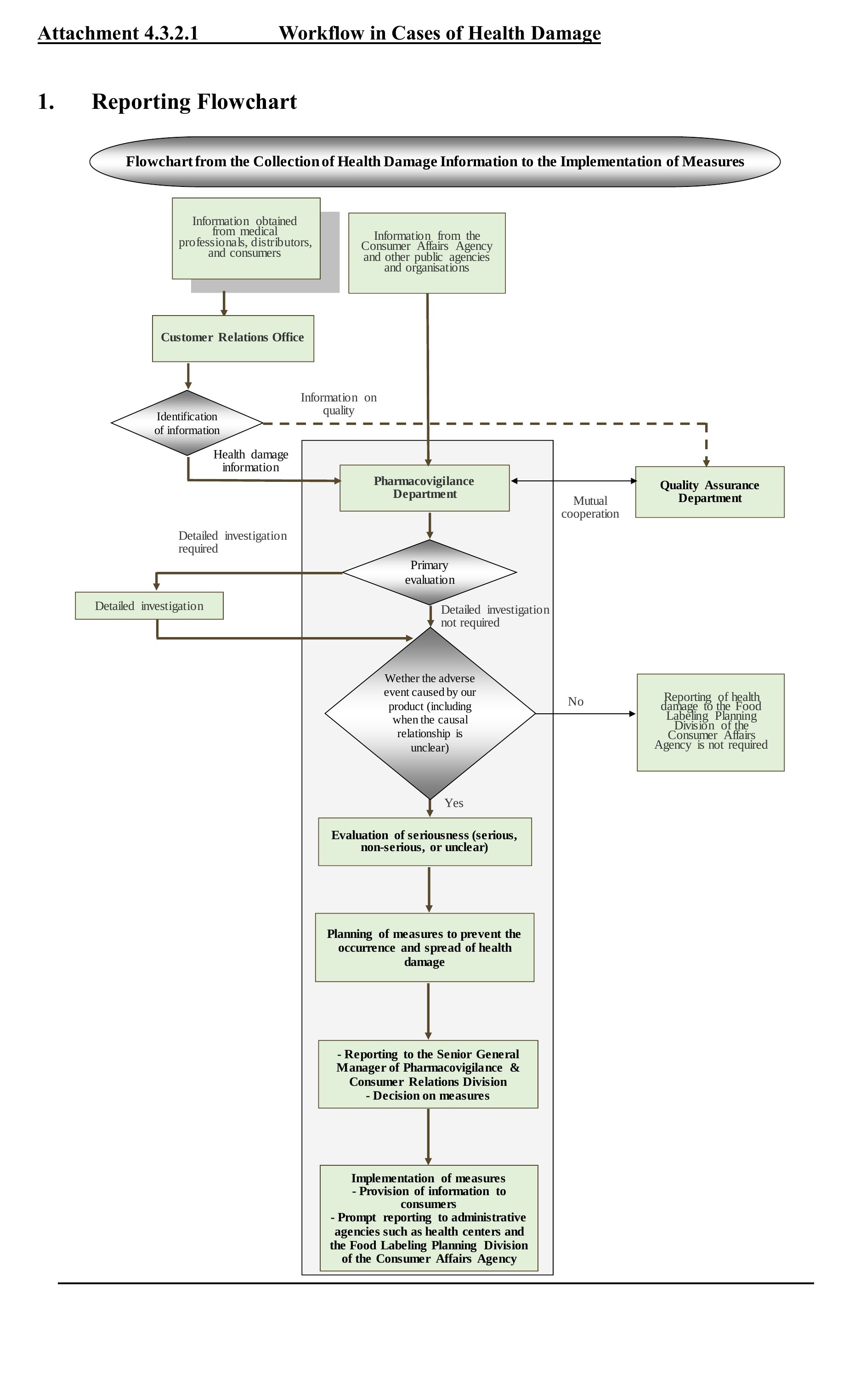
The company's own Reporting Flowchart expressly included cases where 'the causal relationship is unclear'
The company had a Reporting Flowchart covering the process from collecting health-damage information to implementing measures for Foods with Function Claims. One of its decision points contained an explicit parenthetical phrase.
The flowchart referred to an adverse event caused by the company’s product “including when the causal relationship is unclear.”
The “implementation of measures” under that flow included providing information to consumers and promptly reporting to authorities. The Committee said that, if the flowchart were followed, prompt reporting would be required even when causality was unclear. It obtained no reasonable explanation for how this fitted with the separate interpretation that reporting was required only when causality was clear.
Quality management was almost entirely left to one onsite person. Interviews also described a dryer failure, blue mold and a clogged exhaust duct
At the Osaka Plant, about five to six employees worked on the red yeast rice raw-ingredient production line, while the work including quality control was almost entirely entrusted to a person in the Quality Management Group. The report says the same arrangement continued after the line moved to the Kinokawa Plant, and staff shortages had become routine.
In interviews, people described a dryer breaking during manufacture of a relevant raw-material lot, blue mold adhering to the inside of a culture-tank cover, and a deeply clogged exhaust duct discovered when the line was transferred.
The Committee expressly said it was unclear whether these events caused the issue; it also found that, before the March 22 announcement, the company made no proactive attempt to ask manufacturing personnel directly about problems in the manufacturing process.
The plant observations are therefore presented here as interview accounts recorded by the Committee, not as an established scientific cause of the health damage.
The Committee's conclusion: preventive measures were unlikely to work unless consumer safety became the highest value
In its final conclusion, the Committee said that, by early February at the latest, the company should have treated the situation as an emergency requiring a company-wide response with consumer safety as the highest priority.
It acknowledged that investigating cause and causality was important, but warned that too much focus on those questions in a food accident can delay appropriate and prompt information to consumers.
The official English translation concludes that, unless consumer safety is instilled as the highest value and embodied in day-to-day operations, preventive measures are unlikely to be effective.
The Japanese original uses the expression 「画餅に帰す」 for this final warning. The English wording above follows Kobayashi Pharmaceutical’s official translation rather than translating that phrase independently.
What the report says about the background
For its subsequent review of the response, the Board treated the three inside directors — the Chairman, President and Senior Executive Director — as having special interests and excluded them from deliberations and resolutions. The remaining four Outside Directors would conduct that review. The three-lawyer Fact-Finding Committee was commissioned to establish the factual sequence and examine the internal-control and quality-management systems that would form its foundation (pp. 9–11).
The Committee investigated from April 26 to July 22. It relied on voluntary cooperation, had no compulsory investigative powers and faced limits on verifying the completeness of documents and interviews. It therefore did not guarantee that its findings were complete (pp. 11–12).
Corrections to this article
Note 03 now identifies the account as the Committee’s reconstruction from materials and participant interviews because no recordings or minutes were kept (p.37). Note 06 distinguishes the March 4 TEAM-F proposal from the later general-manager meeting’s agreement (p.47). Note 07 adds p.76 for the discussion-item classification and material-distribution practice, retaining p.77 for discussion times. Note 11 restores the official translation’s qualified conclusion that measures were unlikely to work, rather than would not work (p.87).