
What happened?
In 2019, Japan Post Insurance policies came under scrutiny over replacement contracts and other sales practices that may have gone against customers’ intentions and caused them disadvantages. Japan Post Group began reviewing roughly 30 million policies, including policies terminated during the previous five years, covering about 19 million policyholders. Printed page 2 states that investigations needed for cause analysis and recommendations were largely complete, while the investigation of specified cases and related work had not yet finished.
The Special Investigation Committee established by Japan Post Holdings, Japan Post and Japan Post Insurance interviewed 649 people. It also surveyed 89,483 Japan Post employees engaged in selling Japan Post Insurance products and received 38,839 responses. Its report, published on December 18, 2019, has 155 PDF pages including the cover and contents, with the body numbered 1-148. It examines not only individual contracts but also how questionable sales methods spread and how targets, incentives, management, investigations and audit systems contributed. The English text below is a From Reports translation and summary of the Japanese original; translated phrases are not official translations.
Background overview: Japan Post Insurance (Wikipedia)
Twelve passages that stood out
The report preserves unusually concrete details about internal names for sales techniques, the position of top performers, training and study groups, pressure to meet targets, and the mechanisms that were supposed to detect problems. These twelve notes focus on the everyday operating practices around the misconduct while keeping interview testimony separate from the committee’s own findings.
A sales method centered on getting customers through the first two years had its own name: the 'two-year sales pitch'
The report says some salespeople avoided explicitly telling customers that the premium-payment period was only two years, but still framed the sale around making it through the first two years and recommended premiums beyond the customer’s realistic ability to pay. The committee suggests two possible reasons for the focus on two years: many contracts could be converted to paid-up status after that point, and, before April 2019, sales allowances no longer had to be repaid after two years if the contract later terminated. Paid-up status means stopping premium payments and reducing coverage to an amount supported by premiums already paid.
The method had a recognized internal name—the “two-year sales pitch”—and the committee says it was widely known among salespeople.
Interview testimony also described a pattern in which contracts sold this way looked healthy through year two but then showed a conspicuous decline in retention during years three to five.
One manager said the 'two-year sales pitch' had existed for 40 years
The committee says variants of this sales method had existed for a long time, but falling assumed interest rates made the disadvantages more visible in later years.
In an interview, one financial-sales division head said the method had existed for 40 years.
Other interviewees explained that when interest rates were much higher, converting a policy to paid-up status after two years did not necessarily leave the customer worse off. As rates fell, however, the economics changed while some staff continued to pass along the old method simply because it had long been used.
One joint-sales role was described as the 'cunning one.' Some sales instructors were known as 'ageya'—people expected to lift results
A quality-guidance specialist described an established joint-sales setup in one area: less-skilled salespeople handled appointments and post-application paperwork, while the person with stronger sales ability handled the conversation with the customer. The testimony used a blunt phrase for that conversation role, rendered here as “the cunning one.”
The next section describes some sales instructors who accompanied young or low-performing employees but were also expected to raise their own and the post office’s sales results.
Those instructors were sometimes called “ageya,” a workplace label for people expected to lift a post office’s sales results.
The committee says some instructors used improper sales techniques and that accompanying employees sometimes copied what they saw, creating another route by which the methods spread.
Statement recorded by the committee
An insurance-sales quality instructor's account of why paired sales visits led to higher-premium pitches (site translation of Japanese testimony, excerpt)
With two salespeople working together, a contract with monthly premiums of 20,000 to 30,000 yen would not be enough to reach the target (split between two people, it amounted to only 10,000 to 15,000 yen per person). The premium per contract therefore had to be raised. This made techniques such as the two-year sales pitch necessary to persuade customers to sign contracts with higher premiums. Such improper solicitation spread in this way. Even when targets were achieved through these methods, the branch praised the results.
About 45% of respondents who had learned improper methods pointed to company-sponsored training as one place they learned them
Among survey respondents who said they had been taught improper solicitation methods or procedures, 9,016 identified company-sponsored training as a source or occasion, 8,351 identified workplace study sessions, and 8,331 identified voluntary study sessions.
Within that subgroup, the shares were about 45% for company-sponsored training and about 42% each for workplace and voluntary study sessions.
The 45% figure is not a share of all sales employees. A footnote also says the company-training category may include private meetings held on the occasion of company training. Interviews separately described improper methods being discussed at post-training social gatherings and practical “real-world” sales stories being exchanged at unofficial study sessions.
A salesperson said a top performer with annual sales in the tens of millions of yen taught new employees the two-year pitch
The committee says improper sales methods could travel beyond a single workplace through personal networks and gatherings where top performers from different regions met and exchanged techniques.
One salesperson said a top performer with annual sales in the tens of millions of yen taught new employees the two-year method. The interviewee said that the same top performer had also told them this style of selling was necessary to become a top performer.
This is interview testimony illustrating how a method could be passed on; it is not a committee finding that every top performer taught or used improper methods.
Some high performers became so important to hitting office targets that managers could not effectively control them
The committee says some managers knew that high-performing salespeople were using improper practices but prioritized the office or branch target, failed to give effective quality guidance, and instead tended to treat those performers favorably.
Where an office depended heavily on a high performer to hit its target, the committee found that the salesperson could sometimes have more influence inside the office than the manager above them.
Interviewees also described postmasters relying so heavily on strong sellers that they did not or could not press into suspected problems, even when people around the seller noticed questionable methods.
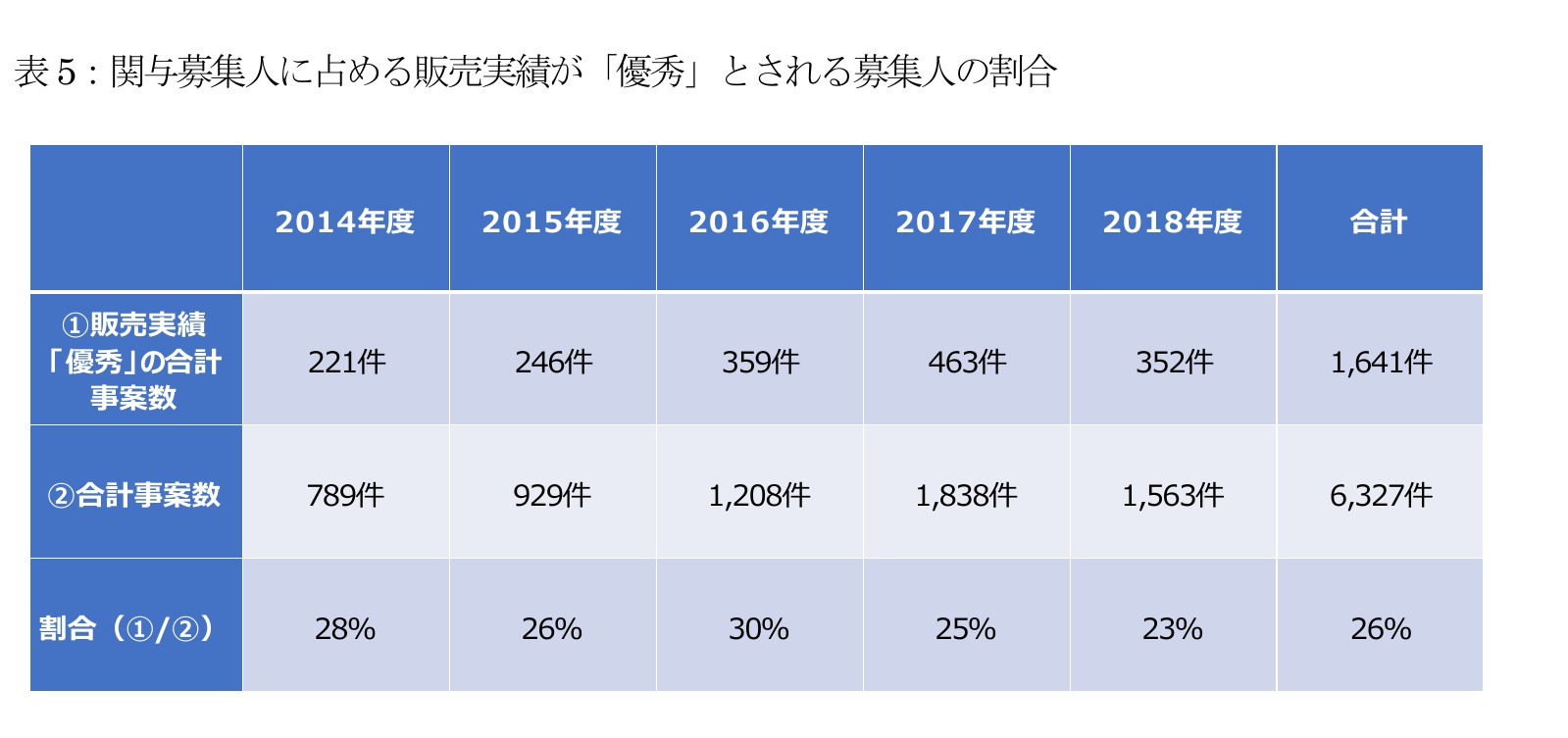
Of the 6,327 cases classified as suspected violations in the committee’s analysis, 1,641 (approximately 26%) involved salespeople rated “excellent” by sales results. Over the five years, those high performers accounted for only about 1.4% of all salespeople on average. These were cases under suspicion, not a count of confirmed violations.
After becoming a '10-million-yen player,' one explanation said it became hard to lower one's standard of living
Interviews about why high performers engaged in improper solicitation include unusually concrete descriptions of sales allowances becoming part of personal household finances.
One former salesperson said that after sales allowances pushed someone into the roughly 10-million-yen annual-income range, there was a strong incentive to keep the following year’s income at about the same level.
A quality-guidance specialist separately said some high performers planned their finances around large allowances and took out home or car loans on the assumption that those payments would continue. Both points are interview testimony.
One interviewee described low performers being singled out at morning assembly and called 'parasites'
The report also records testimony about pressure on employees who were not high performers.
One former salesperson said a section chief from the regional branch sometimes named low performers in front of the entire staff at morning assembly and berated them as “parasites.”
The same interviewee said some employees were driven to tears or resignation and believed that avoiding such treatment was one reason some people resorted to improper solicitation. This is one interview account, not a committee finding that the same practice was used throughout the group.
One salesperson described low performers being kept until 8 or 9 p.m. and made to apologize at morning assembly
The committee says severe target management sometimes included excessive practices referred to as intimidating guidance and reprimands of salespeople with poor performance.
One salesperson described low performers being kept at work until 8 or 9 p.m. and being told at morning assembly to apologize for holding back the post office’s target.
Another interviewee said such management focused on demanding reasons for poor results without teaching how to improve them. A separate account described a chain in which a manager was scolded by the branch for missing a target and then passed the pressure down to salespeople with an instruction essentially meaning “make it happen.”
A salesperson said they were taught that a 'he said, she said' dispute could be survived by simply denying wrongdoing
The committee criticizes the old investigation process for relying too heavily on a salesperson’s own admission. When the salesperson denied improper solicitation, the conduct was often not formally recognized as improper, which the committee says helped minimize the problem and weakened causal analysis and prevention.
Against that background, one salesperson said a manager had taught them that if there was no evidence and the case became one person’s word against another’s, denying the allegation could avoid punishment.
Other interview testimony said suspected improper conduct could remain outside discipline when a clear legal or internal-rule violation could not be established, allowing the salesperson’s evaluation—or even award eligibility—to remain intact.
One salesperson suggested a '3-before/6-after' rule fostered a sense that '4-before/7-after' was allowed
The company used a time window to determine whether a transaction was treated as a replacement contract. “3 before and 6 after” referred to termination of an old policy in the period from three months before to six months after the new policy date. The committee says unclear rules and formalistic operation created room for circumvention.
One salesperson said moving the transaction from “3 before and 6 after” to “4 before and 7 after” would put it outside the replacement category and preserve full sales credit and allowances. They suggested this may have created a sense that the workaround was allowed.
An audit of the improper-sales investigation system was planned—but the audited department was too busy to finish it that fiscal year
Japan Post Insurance’s 2018 internal-audit plan listed establishment of an appropriate insurance-sales management system as a priority. A thematic audit was intended to examine, among other things, the state of efforts to improve sales quality and the system for investigating improper solicitation. The audit reflected concern that replacement-contract rates were rising and existing countermeasures might not be enough.
The audit did not finish in fiscal 2018 because the department being audited, the Sales Management Department, was described as too busy; the work continued into fiscal 2019.
Internal-audit staff also told the committee that audits tended to focus on clerical compliance and that discovering conduct such as improper solicitation through ordinary audit work was difficult.
What the report says about the background
The committee identifies management that prioritized sales targets over proper solicitation, allowances tilted toward new contracts, and investigations that relied too heavily on salespeople’s own admissions as factors that encouraged improper solicitation (printed pp.104-107 / physical PDF pp.111-114).
Corrections to this article
Note 05 distinguishes the instruction given to new employees from what the interviewee said they were told (p.97). Note 08 now identifies a section chief at a regional branch rather than a branch manager (p.100), and note 09 identifies the same witness for the late working hours and morning-assembly account (p.105). Note 11 restores the witness’s conjectural wording about a sense that the workaround was allowed (p.110), and note 12 labels staff comments as testimony. The introduction clarifies that specified-case investigations were unfinished when the report was submitted (p.2).